

Having the right drone spare parts ready is what separates a quick fix from a long, frustrating flying hiatus. Imagine proactively having a bunch of extra propellers and a new battery on hand. An accident is then transformed from a catastrophe into a minor incident, and you're back in the air in no time.
Why the right spare parts extend the life of your drone
Investing in spare parts for your drone is probably the smartest thing you can do as a pilot. Think of it as a first-aid kit for your equipment. Instead of waiting for a crash to happen and then having to hunt for parts with long delivery times, you can minimize downtime and maximize flight time with a small stock of the most common items.
A crash or an unexpected technical fault definitely doesn't have to mean the end for your drone. Many common problems, such as a broken propeller or a battery that has lost its punch, are actually surprisingly easy to fix yourself. By learning basic maintenance, you not only significantly extend the life of the drone, but you also save money on expensive workshop visits.
Build confidence with practical knowledge
When you learn to replace parts yourself, you gain a much deeper understanding of how your drone actually works. This knowledge builds confidence and makes you a more competent and responsible pilot. Every small repair is a learning experience that makes you better equipped the next time something happens.
By keeping track of which spare parts a drone most often needs, you can prepare smartly. This proactive mindset ensures that your equipment always performs at its peak when it counts.
Owning a drone isn't just about flying – it's about understanding and taking care of the technology. The right spare parts are your best insurance for uninterrupted creativity and new discoveries.
To make things easier, we've broken down everything you need to know in this guide. We focus on making maintenance and repairs accessible and less intimidating. The goal is for you to feel confident handling the most common problems and knowing exactly what to do when an accident occurs.
Here are some of the biggest benefits of having spare parts close at hand:
- Less downtime: Get back in the air in minutes instead of days or weeks.
- Lower costs: Replacing a part yourself is significantly cheaper than sending the drone in for service.
- Longer lifespan: Regular maintenance with quality parts keeps your drone in top condition for longer.
- Better performance: New, fresh components like propellers and batteries ensure the drone flies stably and efficiently.
By investing a little time and money in the right spare parts for your drone, you ensure that it remains a reliable partner on your adventures, whether you're taking photos, filming, or just enjoying the freedom of the air.
Which parts wear out first? A guide to common replacements
Knowing which drone spare parts are most commonly needed is essential for keeping costs down and flight time up. Some parts are simply designed to take the impact in an accident, while others wear out after many hours of flight. If you learn to recognize the signs of wear, you can stay one step ahead and avoid being stuck on the ground when flying conditions are perfect.
Think of your drone a bit like a car. It has its wear parts – like tires and oil – that need to be replaced regularly for everything to run as it should. For a drone, propellers and batteries are the most obvious consumables. Always having an extra set of these at home is a simple habit that every serious drone pilot should have.
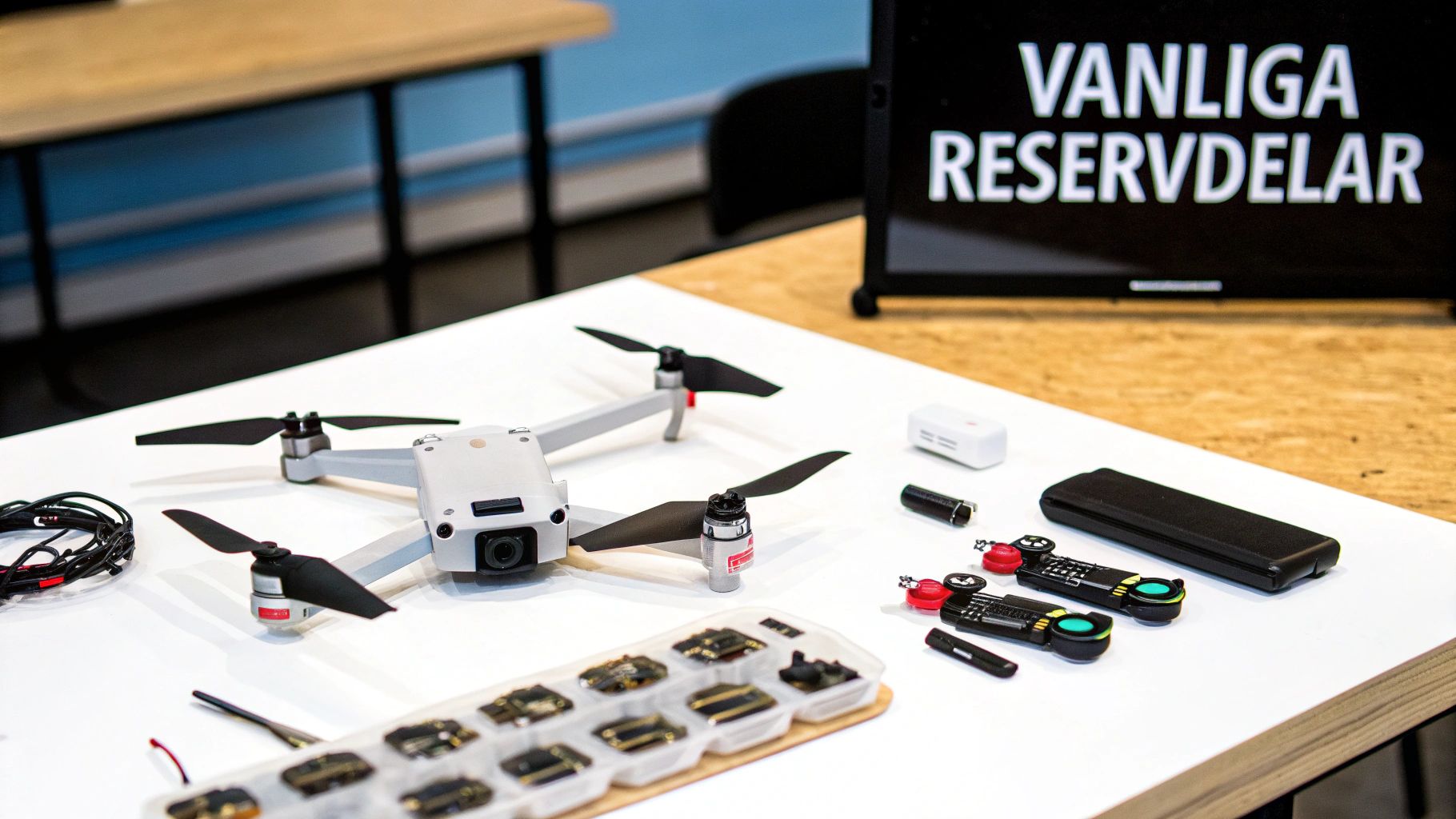
In Sweden, where drones have become an increasingly common tool in professional life, this is extra important. An industry survey from Transportföretagen shows that drones are used extensively for everything from inspections (41.6%) to photography (34.4%). This naturally drives the demand for reliable drone spare parts, such as propellers and batteries, to keep fleets in the air. For many small businesses, this is critical to operations. If you want to dive into the numbers, you can find the industry survey results on the Transportföretagen website.
Propellers – your first line of defense
Propellers are without a doubt the spare part you will replace most often. They are not just the drone's wings, but also act as its bumpers. The smallest nick, crack, or bend can create vibrations that ruin your footage and put unnecessary wear on the motors.
- Warning signs: Make it a habit to quickly inspect the propellers before every flight. Look for visible damage, such as marks from a branch or cracks after a slightly too hard landing.
- Action: Replace a damaged propeller immediately. It's cheap insurance against much more expensive problems. Many choose to replace all propellers at the same time to ensure everything is in perfect balance.
Are you new to the drone world and feeling a bit uncertain about the basics? Then we recommend our complete guide to drones for beginners for more practical tips.
Batteries – power sources with an expiration date
Modern drone batteries, usually of the LiPo (Lithium Polymer) type, are incredibly powerful but also quite sensitive. Their capacity gradually decreases with every charge, and they can be damaged if handled incorrectly or discharged too deeply. A tired battery gives you shorter flight time and can, in the worst case, cause the drone to lose power mid-air.
A battery that has swollen or changed shape is a serious safety risk. Stop using it immediately and ensure it is recycled correctly according to your local regulations for hazardous waste.
The Motors – listen for the warning signs
The motors are the heart of the drone, and they work hard during every flight. Over time, bearings can wear out, leading to poorer performance and strange noises.
- Warning signs: Listen for a scraping, whining, or uneven sound from a specific motor. If a motor feels sluggish when you spin it by hand, or if the drone constantly wants to pull to one side, it might be time for a replacement.
- Action: Replacing a motor is a bit more advanced, but definitely doable if you're a bit handy. It is a crucial repair to restore the drone's stability and power.
Landing Gear – cheap protection for expensive equipment
Landing gear is more than just a pair of feet for your drone; it is the primary shock absorber protecting expensive items like the camera and gimbal. A cracked or broken landing gear can cause the full force of a hard landing to go straight into the gimbal, which could end in a very expensive repair. Replacing the landing gear is usually both simple and cheap – a smart investment to protect your valuable camera equipment.
To provide a quick overview, we have compiled a table of the most common spare parts.
Quick Guide to Common Spare Parts
This table helps you quickly identify different parts, understand why they need to be replaced, and get a feel for the difficulty of the job.
| Spare Part | Primary Function | Reason for Replacement | Replacement Difficulty |
|---|---|---|---|
| Propellers | Provide lift and steering | Wear, crash damage, cracks | Easy (often tool-less) |
| Batteries | Power supply | Reduced capacity, swelling, damage | Easy (plug-and-play) |
| Motors | Drive the propellers | Worn bearings, overheating, crash | Medium (requires soldering/screwing) |
| Landing Gear | Protects during landing | Cracks, broken parts after crash | Easy to Medium (usually screws) |
| Gimbal/Camera | Stabilizes and takes images | Crash damage, motor failure | Difficult (often requires expertise) |
| Body/Arms | Drone chassis | Cracks after crash, fatigue | Medium to Difficult (requires disassembly) |
Keeping an eye on these parts and their typical lifespan makes you a smarter and safer drone pilot. It saves both time and money in the long run.
How to choose spare parts that actually fit
Accidentally buying the wrong drone spare parts is a classic mistake – frustrating, time-consuming, and often expensive. It's a bit like buying a random mobile charger and just hoping for the best. The result is rarely good, and for your drone to fly safely and perform at its peak, every component must fit perfectly.
The good news is that you don't need to be an engineer to choose correctly. With a few simple tricks, you can quickly ensure that a part is made for your specific model. Learning this not only saves you money and headaches but also gives you the knowledge to make smart decisions for your equipment.
Understand the difference between OEM and Third-Party
When searching for spare parts, you will quickly encounter two terms: OEM and third-party. Knowing what distinguishes them is the foundation of a good purchase.
- OEM (Original Equipment Manufacturer): These are original parts, manufactured by the same company that built your drone, for example, DJI. They guarantee perfect fit, quality, and performance. The downside? They usually cost a bit more.
- Third-Party: These parts are produced by other companies. They can be cheaper and sometimes offer unique upgrades, such as carbon fiber propellers for better response. However, quality can vary wildly – from very good to downright substandard.
For critical parts like batteries and motors, it's almost always best to stick with OEM to avoid safety risks. For simpler items like landing gear or propellers, a well-known third-party brand can be a really smart and affordable alternative.
Your guide to getting it right every time
Double-checking compatibility is the absolute most important step. Use this checklist to make sure you're buying the right drone spare parts – every time.
- Identify your exact drone model: It's not enough to know you have a "DJI Mini". Is it a Mini 2, Mini 3 Pro, or a Mini 4 Pro? The model name is almost always on the drone's arms or the original box.
- Look for part numbers: Many spare parts have a unique part number (often called SKU or Part Number). Compare the number on your broken part with the one in the online product description. This is the absolute safest method.
- Read the product description carefully: A reputable seller always lists which drone models a spare part fits. Look for a clear list that includes your specific model. If the information feels vague, be cautious.
Taking a chance on a part that "looks the same" rarely ends well. A minimal difference in size, shape, or connection can make the part completely unusable and, in the worst case, damage your drone.
For brands like DJI, it's extra important to be thorough, as their parts rarely fit between different series. If you feel uncertain, check out our guide that goes into depth with specific DJI spare parts for more detailed help.
How material choice affects your flight
The choice of spare part isn't just about fit, but also about material. Different materials provide completely different properties that directly affect how your drone behaves in the air. This is a perfect opportunity not just to repair, but to actually upgrade.
Plastic vs. Carbon Fiber for propellers:
- Plastic propellers: Standard on most consumer drones. They are cheap, flexible, and handle minor bumps fairly well. However, their flexibility can make the flight slightly less responsive.
- Carbon fiber propellers: Considerably stiffer and lighter. The stiffness reduces vibration and provides a snappier response from the motors, which can lead to more stable video and a more precise flight feel. The downside is they are more brittle and can shatter in a crash.
LiPo vs. LiHV for batteries:
- LiPo (Lithium Polymer): The standard battery in most drones. Charged to 4.2V per cell, offering a good balance between performance and lifespan.
- LiHV (High Voltage Lithium Polymer): Can be charged up to 4.35V per cell. The higher voltage provides a small extra boost in power and flight time, something often appreciated by FPV racers. The downside is they can wear out faster if constantly charged to the maximum.
Choosing the right material and type of spare part can therefore be the difference between a simple repair and a noticeable improvement in performance. By being a bit methodical, you ensure that every cent you spend on your drone is a smart investment.
Installing common spare parts – a step-by-step guide
The thought of taking your drone apart yourself can feel a bit scary the first time. But you know what? Most common repairs can be handled perfectly fine at home at the kitchen table with a few simple tools. It's more about patience and being thorough than being a technical genius.
Think of this guide as your personal maintenance buddy. We break down the replacement of the most common wear parts into simple, clear steps that are easy to follow. The goal is for you to feel confident enough to do basic maintenance yourself, saving you both time and money.
Before you even pick up the screwdriver, however, it is crucial that you have the right spare parts for your specific drone model. This image shows three simple steps to ensure you buy the right gear from the start.
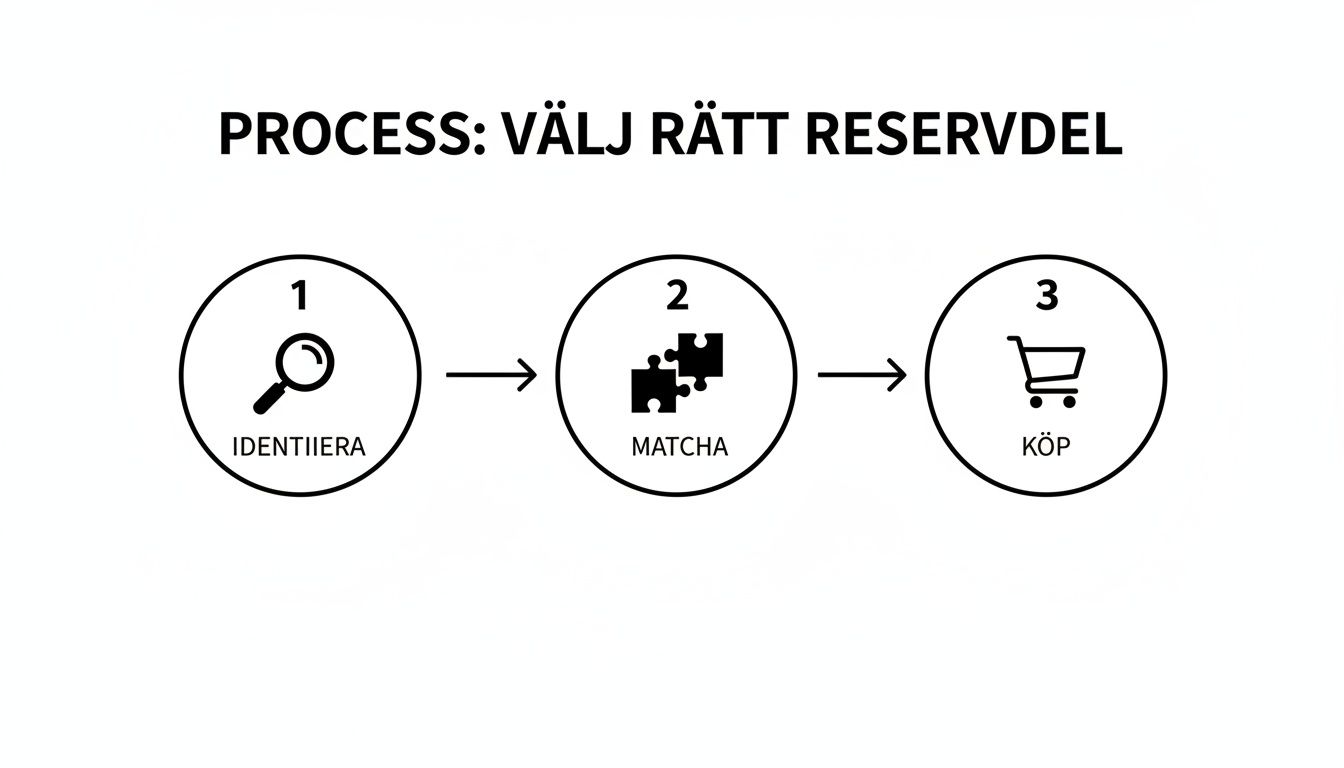
By systematically checking your drone model, matching part numbers, and then making an informed purchase, you avoid that frustrating feeling of having ordered the wrong part.
How to replace propellers quickly and safely
Replacing propellers is the most common and simplest repair you will do. A propeller with even the slightest damage can create vibrations that ruin your footage and, at worst, cause a crash.
What you need:
- New propellers (make sure you have the correct ones for clockwise and counter-clockwise rotation)
- Depending on the model: a small tool or just your hands
Step by step:
- Safety first: Ensure the drone is completely turned off and, most importantly, that the battery is disconnected. This is a rule that must never be broken during maintenance.
- Find the right rotation: Drones have two types of propellers: clockwise (CW) and counter-clockwise (CCW). They are almost always marked with a color or symbol. Make sure you match the new propeller with the old one.
- Remove the old propeller: On many modern drones, such as those from DJI, you push the propeller down slightly and twist to release it. Older models may have a nut you need to unscrew.
- Install the new one: Place the new propeller (with the correct rotation direction!) on the motor shaft. Push down and twist until it clicks into place, or tighten the nut if your model has one. Don't over-tighten, just make sure it's secure.
- Do a quick check: Gently spin the propeller with your finger. Does it sit firmly? Does it rotate freely without hitting anything? Good, then you're done!
Replacing the landing gear
The landing gear is the drone's shock absorber. It's the part that takes the impact and protects expensive components like the camera and gimbal during a hard landing. Replacing a broken gear is a simple and cheap form of insurance.
What you need:
- New landing gear
- A small screwdriver (usually Phillips)
Step by step:
- Turn off, disconnect: Just like before, the battery comes out first. Always.
- Locate the screws: Turn the drone over and find the screws holding the damaged landing gear. They are usually located right where the leg attaches to the drone's arm.
- Unscrew the old part: Use the correct screwdriver and loosen the screws carefully. Place them in a safe spot so they don't roll away and disappear.
- Install the new gear: Put the new landing gear in place and screw it in with the original screws. Tighten until secure, but avoid over-tightening as the plastic could crack.
Replacing a motor is a different story altogether. It's much more complicated and often requires soldering and calibration afterwards. If you suspect a motor has failed and you feel uncertain, it's usually smarter to take the drone to a professional.
When to call a professional?
Knowing your own limitations is just as important as knowing how to change a propeller. Some repairs require special tools, deep knowledge, and calibration equipment that most hobby pilots simply don't have at home.
Contact an expert if you encounter any of the following:
- Motherboard or internal circuit issues: If the drone is suddenly dead or behaving strangely without any visible damage.
- Damage to the gimbal or camera: These are extremely sensitive and complex pieces of gear. An incorrect repair attempt can make the damage much worse.
- Motor replacement requiring soldering: If you are not an experienced solderer, a small mistake can ruin both the new motor and the drone's speed controller (ESC).
Taking care of your equipment and performing simpler repairs yourself is a truly rewarding part of this hobby. You learn a lot and gain greater confidence. But for the really tricky jobs, an expert is your best guarantee of getting back a drone that is both fully functional and safe to fly.
Upgrade your drone for better performance
Buying drone spare parts isn't just about fixing something that broke. For many pilots, this is where the fun, creative, and technical side of the hobby really begins – a chance to customize the drone, push its performance, and adapt it for a brand new purpose.
By replacing a few well-chosen components, you can transform a standard drone into a high-performance machine. Whether you're chasing higher speeds, want to fly further, or are craving a brand new flight experience, there's an upgrade that will take you there.
Aim for higher speed and acceleration
Curious about FPV racing, or do you just want a drone that reacts lightning-fast to your commands? Then you should look at the motors and the battery. Switching to stronger motors with a higher KV rating (RPM per volt) is the most direct way to increase speed. But it's not quite that simple.
Stronger motors are thirstier and require more current, which places higher demands on both the battery and the electronic speed controller (ESC).
- Motors: Choose motors known for their power and efficiency, tailored to the type of flying you want to do.
- Battery: You will need a battery with a higher discharge capacity (C-rating). This number shows how quickly the battery can deliver its power. A C-rating that is too low will throttle the motors and can, in the worst case, damage the battery.
- Electronic Speed Controllers (ESCs): These must be built to handle the increased current (Amperes) that the new motors draw. Undersized ESCs can overheat and fail – in mid-air.
Think of it as a system. An upgrade in one place often needs support from other parts for everything to work safely and optimally.
Extend your range for epic views
For those who love landscape photography or long-distance flying, range is everything. If you're constantly fighting weak signal warnings, an upgraded antenna can make a huge difference. The antennas that come as standard are often a compromise between performance and size.
Switching to a "long-range" antenna, either on your remote controller or on the drone itself, can provide a dramatic improvement in signal strength and stability. This gives you the freedom to explore further without losing the video link.
Just remember that different antennas work in different ways. An omnidirectional antenna sends the signal evenly in all directions, while a directional antenna focuses the power in a narrower beam to reach maximum distance in a specific direction.
Transform your flight with FPV
Perhaps the most revolutionary upgrade of all is switching to an FPV (First Person View) system. Instead of looking at the drone from the ground, you get to see exactly what the drone's camera sees, in real-time, through a pair of video goggles. The feeling is incredibly immersive – it's like sitting in the cockpit yourself.
Converting to FPV requires a few new parts:
- An FPV camera: A small, lightweight camera mounted on the front of the drone.
- A video transmitter (VTX): Wirelessly sends the video signal from the camera.
- Video goggles or a screen: Receives the signal from your VTX and displays the image to you.
This upgrade turns your drone from a tool into a pure experience. If you're curious about taking the plunge, there are complete kits that make it easier to get started. Feel free to read our guide on choosing the right FPV drone kit to learn more.
By viewing drone spare parts as opportunities rather than just repairs, you can unlock your drone's true potential and tailor it perfectly for your adventures.
Handle and store batteries and parts safely
Handling your drone spare parts correctly is a fundamental part of being a responsible drone pilot. Especially when it comes to LiPo batteries, it's not just a matter of extending the life of your gear – it's a matter of sheer safety.
A mismanaged battery is no toy. It can pose a real fire risk, which is why knowledge of safe handling is invaluable. With a few simple routines in place, you protect yourself, your home, and your investment.
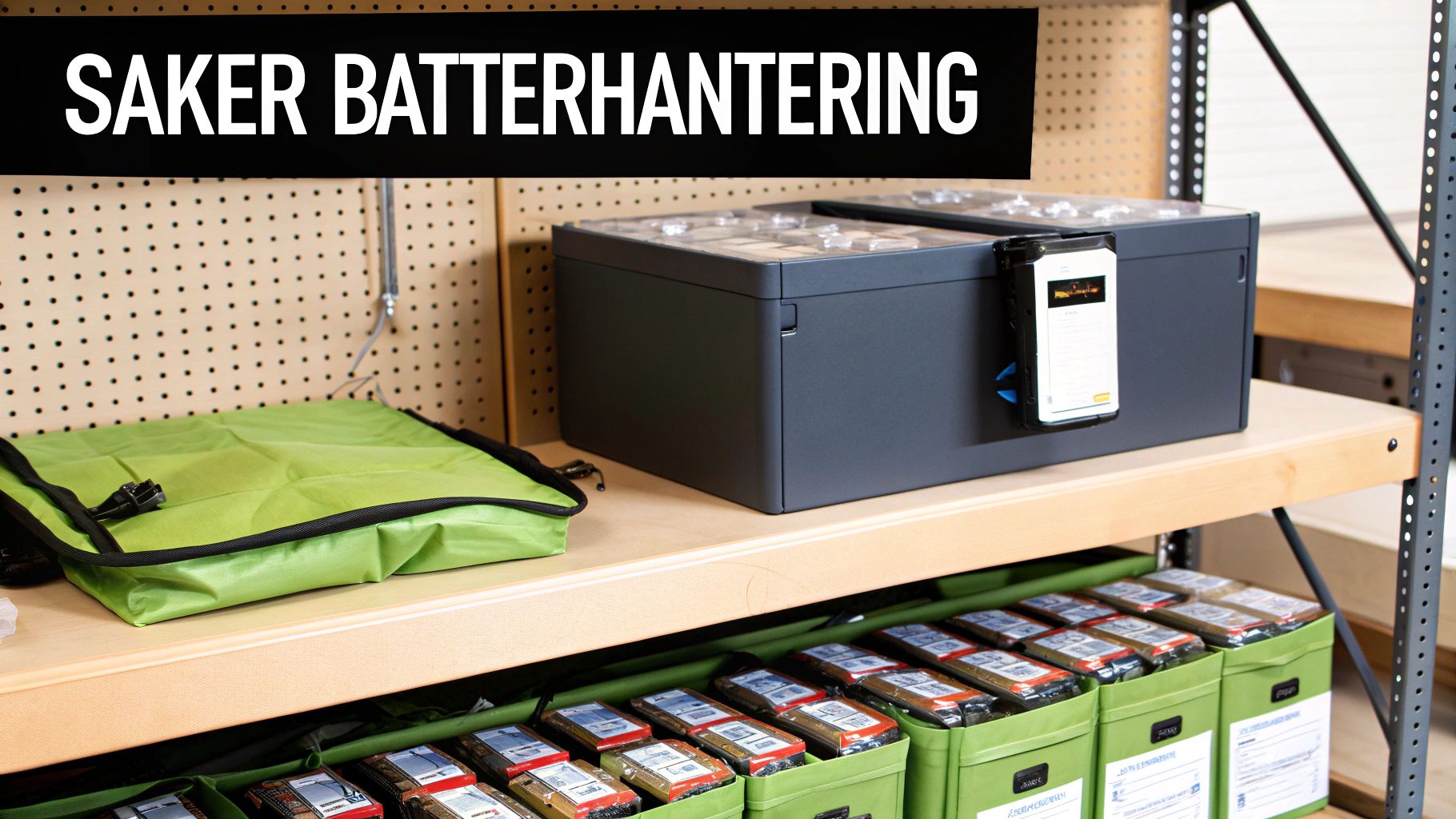
Best practices for battery safety
Lithium Polymer (LiPo) batteries are incredibly powerful but also sensitive. Respect is key when handling them.
- Never charge a damaged battery: If you see a battery that is swollen, has taken a hit, or has visible damage, it's a ticking time bomb. Do not use it. Absolutely do not charge it.
- Store them fire-safely: A fireproof LiPo bag or a metal ammunition box is cheap insurance. Should an accident occur, it can prevent a disaster.
- Use the correct charger: Always use a charger designed for LiPo batteries and double-check that the settings are correct for your specific battery.
- Never leave charging unattended: Charge batteries where you can see them, on a non-flammable surface, and far away from flammable materials.
When it comes to long-term storage, a LiPo battery should neither be fully charged nor completely empty. The golden rule is "storage voltage," which corresponds to approximately 3.8 volts per cell (around 50-60% charge). Most modern, smart chargers have a special storage mode that fixes this for you.
Responsible handling is becoming increasingly important. The Swedish Transport Agency has reported a concerning increase in drone incidents at Swedish airports – from 21 events in 2020 to 46 a year later. This shows how crucial functioning equipment is for general aviation safety.
Organize your other spare parts
Keeping your other drone spare parts organized not only saves time and frustration, it also protects sensitive components from breaking unnecessarily.
A simple storage box with adjustable compartments is a good start. Sort parts by type: a compartment for propellers, one for screws, one for landing gear, and so on. More sensitive items like extra camera modules or sensors should be stored in anti-static bags to protect them from dust, moisture, and static electricity.
A specially adapted case can provide extra protection, like this convenient storage solution for Air 2S batteries which also fits other small parts perfectly. By having a system in place, you'll quickly find what you need when an accident happens.
Frequently asked questions about drone spare parts
Diving into the world of drone spare parts can feel overwhelming at first. A lot of questions often come up. To make it easier for you, we've gathered the most common concerns and provided straightforward, simple answers summarizing the most important points from the guide.
How often do I need to replace propellers?
Short answer: more often than you think. Make it a habit to glance at your propellers before every flight. It only takes a few seconds and can be the difference between a successful trip and an unnecessary crash.
See even the smallest crack, nick, or bend? Replace it immediately, even if the damage looks tiny. A damaged propeller creates imbalance, makes the drone unstable, and can, in the worst case, fail completely in mid-air. A smart habit is to replace the entire set at once to ensure everything is perfectly balanced. Think of it as the cheapest insurance you can give your drone.
Can I use parts from another brand?
In most cases, the answer is a clear no. For critical parts like batteries, motors, and motherboards, you should always stick to original parts (OEM) or third-party parts explicitly approved for your specific model.
Taking a gamble with an incompatible part is asking for trouble. It can lead to everything from poor performance to the drone behaving completely unpredictably – plus it voids your warranty immediately. Sure, for simpler things like screws or certain landing gears it can sometimes work, but then you must be extremely thorough and double-check all dimensions and specifications.
Buying the right part from the start is always cheaper than fixing the problems an incorrect part can cause. Safety and compatibility must always come first.
Where is the best place to buy spare parts?
There are several good ways to go about it. You can buy directly from the manufacturer (like DJI), through authorized retailers, or from specialized online stores that focus on drones and RC gear.
Buying from the manufacturer or an authorized dealer ensures you're getting genuine parts. Specialized stores, on the other hand, often have a wider assortment of both original and high-quality third-party options, sometimes at a better price and with faster delivery.
What is most important to consider with batteries?
Battery care is essential, both for safety and for the batteries to last a long time. For LiPo batteries, there are three golden rules you should never cut corners on:
- Never discharge them completely: Avoid flying until the battery is stone dead. Land with a good margin.
- Store them smartly: Not going to fly for a few days? Use the battery's "storage mode" which discharges/charges it to approximately 50-60%.
- Safety first: Always store batteries in a cool and fire-safe place, preferably in a dedicated LiPo bag. Never charge a battery that is hot, swollen, or damaged.
Need reliable spare parts or looking to upgrade your gear? At ActionKing, you'll find one of the Nordic region's largest selections of drone accessories and spare parts. We offer fast delivery and everything you need to keep your drone in the air. Explore our range at Actionking.se.


