

A crank radio is your insurance when everything else stops working. It is a completely independent radio that requires neither the power grid nor regular batteries to function, making it invaluable when the power goes out or a crisis occurs.
Why a Crank Radio Is the Most Important Item in Your Emergency Kit
Imagine a storm rolling in. Suddenly, everything goes dark and quiet. The power is out, the mobile network is down, and you are completely cut off from the outside world. How do you find out what is happening, where to go, or if the danger has passed?
It is precisely in these situations that the crank radio becomes your absolute best friend. It isn't just a gadget, but your direct link to vital information from authorities when all other technology has given up.
Unlike our modern devices, which are entirely dependent on electricity or the internet, the crank radio creates its own power. By cranking for just a few minutes, you generate enough energy to listen to news and important messages. It is this simple but ingenious function that makes it so incredibly reliable.
The Indispensable Link to Public Information
When a major crisis hits Sweden, Sveriges Radio P4 acts as the official emergency channel. It is via P4 that you receive Important Public Announcements (VMA), also known as "Hesa Fredrik," providing crucial instructions and status updates.
A crank radio ensures that you are guaranteed to receive these broadcasts, regardless of what is happening around you. It’s about getting information regarding:
- Evacuation orders and where you can go to stay safe.
- Warnings about everything from extreme weather to other acute threats.
- Instructions on where to find clean water, food, or medical care.
- Status updates on how the crisis is developing and when the danger is over.
In an uncertain situation, access to accurate information directly from the source is absolutely critical. It helps you make the right decisions and avoid falling for rumors and misinformation. A crank radio is your guarantee of exactly that.
This type of equipment has seen a major surge in popularity in Sweden, especially after storms and other events that exposed the vulnerability of our modern systems. A 2020 survey showed that approximately 15 percent of Swedish households own a crank radio, a figure that is steadily increasing as more people understand the importance of home preparedness.
More Than Just a Radio
Today's crank radios are rarely just a radio. They have evolved into smart, multi-functional tools designed for both crisis and adventure. Many models feature a built-in flashlight, a power bank to give your phone a little extra juice, and even SOS alarms to call for attention.
For the outdoor enthusiast, it is an obvious addition to the pack, but it serves an equally vital role at home in the emergency kit. It can even complement other smart gear, such as the advanced mosquito repellant lamp Nitecore EMR25, to create a complete solution for both safety and comfort outdoors.
Here is a quick guide to why the crank radio is a cornerstone of all home preparedness.
Why You Need a Crank Radio: Your Quick Guide
A fast overview of the five primary reasons to include a crank radio in your home preparedness kit.
| Reason | Explanation |
|---|---|
| Always Powered | Works independently of the power grid thanks to the hand crank and often solar cells. |
| Vital Information | Provides access to SR P4 and VMA when other channels are down. |
| Multi-functional | Built-in flashlight and power bank make it a versatile tool. |
| Robust & Reliable | Built to withstand tough conditions and work when it really matters. |
| Easy to Use | Requires no technical prior knowledge – just start cranking and listen. |
In short, a crank radio is a small investment that can make a huge difference for your and your family's safety.
How the Technology in a Crank Radio Actually Works
How can you create power just by cranking a handle? It sounds almost like magic, but the technology is both simple and ingenious. It is all based on an old, proven principle called electromagnetic induction.
Inside every crank radio hides a small generator, or a dynamo as it is also called. When you turn the crank, a magnet spins inside a coil of copper wire. This movement creates an electrical voltage in the coil, and presto – you have generated power. It's the exact same principle that makes your old bicycle light shine when you pedal. Your own muscle power is simply converted into electricity.
The power created is then sent directly to the radio's built-in, rechargeable battery. The battery acts as a small energy bank that powers everything from the radio receiver and flashlight to the USB port.
Four Ways to Reliable Power
A modern crank radio is built to be extremely reliable. Therefore, it almost always has several different ways to receive power, so you are never left helpless. This smart redundancy is what makes it an indispensable tool in a crisis.
The four most common power sources are:
- The Hand Crank: Your absolute lifeline when everything else fails. A few minutes of cranking provides enough power for a long period of radio listening. You are never dependent on anything other than your own arm strength.
- The Solar Panel: Perfect for maintenance charging. Place the radio in a sunny window or outdoors, and the battery will fill up slowly but surely, completely without effort.
- Internal Battery: Prepared for most things. Before a crisis becomes a reality, you can fully charge the internal battery via a standard USB cable. This gives you a fully charged unit ready for immediate use.
- Spare Batteries: Extra security. Many models also have a compartment for standard AA or AAA batteries, providing you with an additional backup if all other options fail.
This flow shows how a crank radio becomes your link to the outside world during a crisis, from the moment an event occurs until you can take action.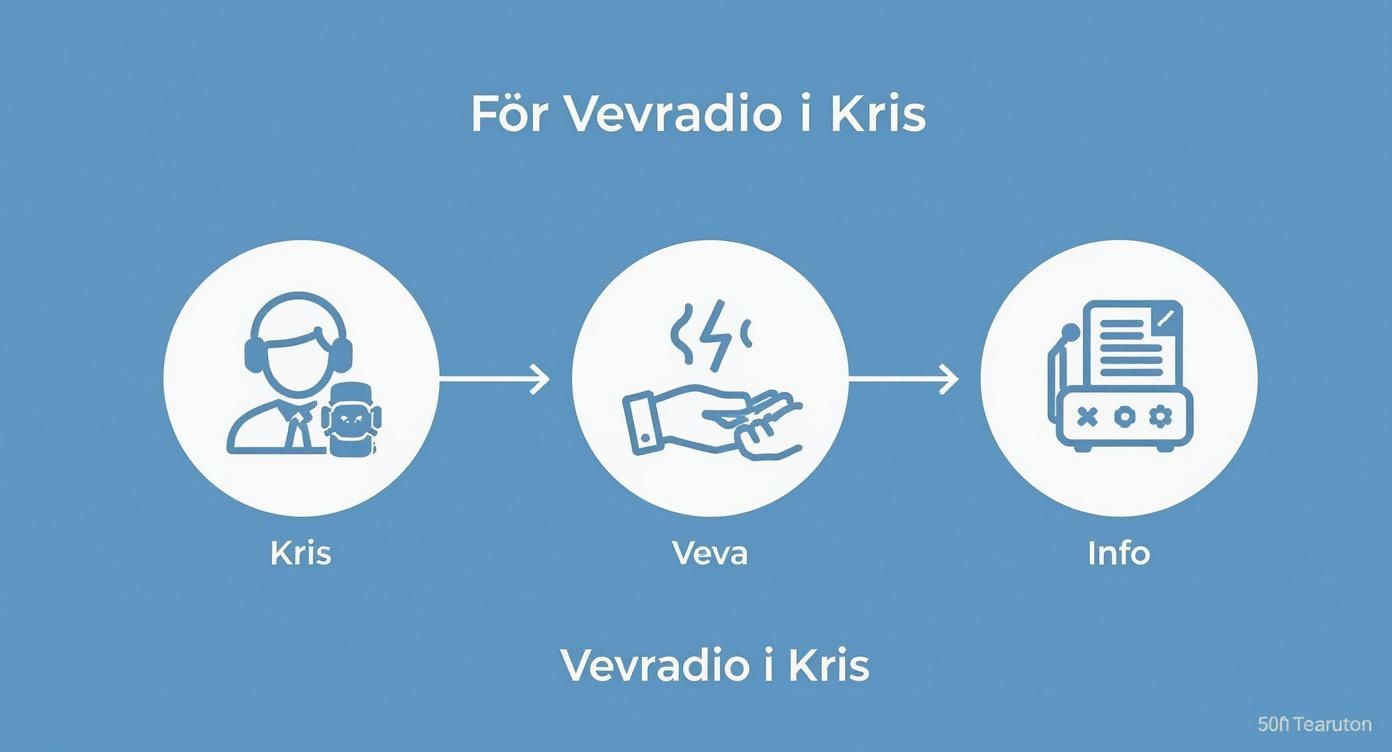
The image clearly illustrates the simple but vital process where your own power is converted into important information.
Understanding how power is generated and stored isn't just technical geekery. It gives you the knowledge to use your crank radio as efficiently as possible to maximize operating time when it truly counts.
Understanding the exact electrical signals a dynamo creates might be a bit advanced. For the technically inclined, however, there are specialized tools that can visualize the process, such as a portable oscilloscope like the Fnirsi DSO-TC3, which can measure and display electrical waveforms.
By combining different charging methods, you ensure that your crank radio is always ready when you need it most.
Choosing the Right Crank Radio for Your Needs
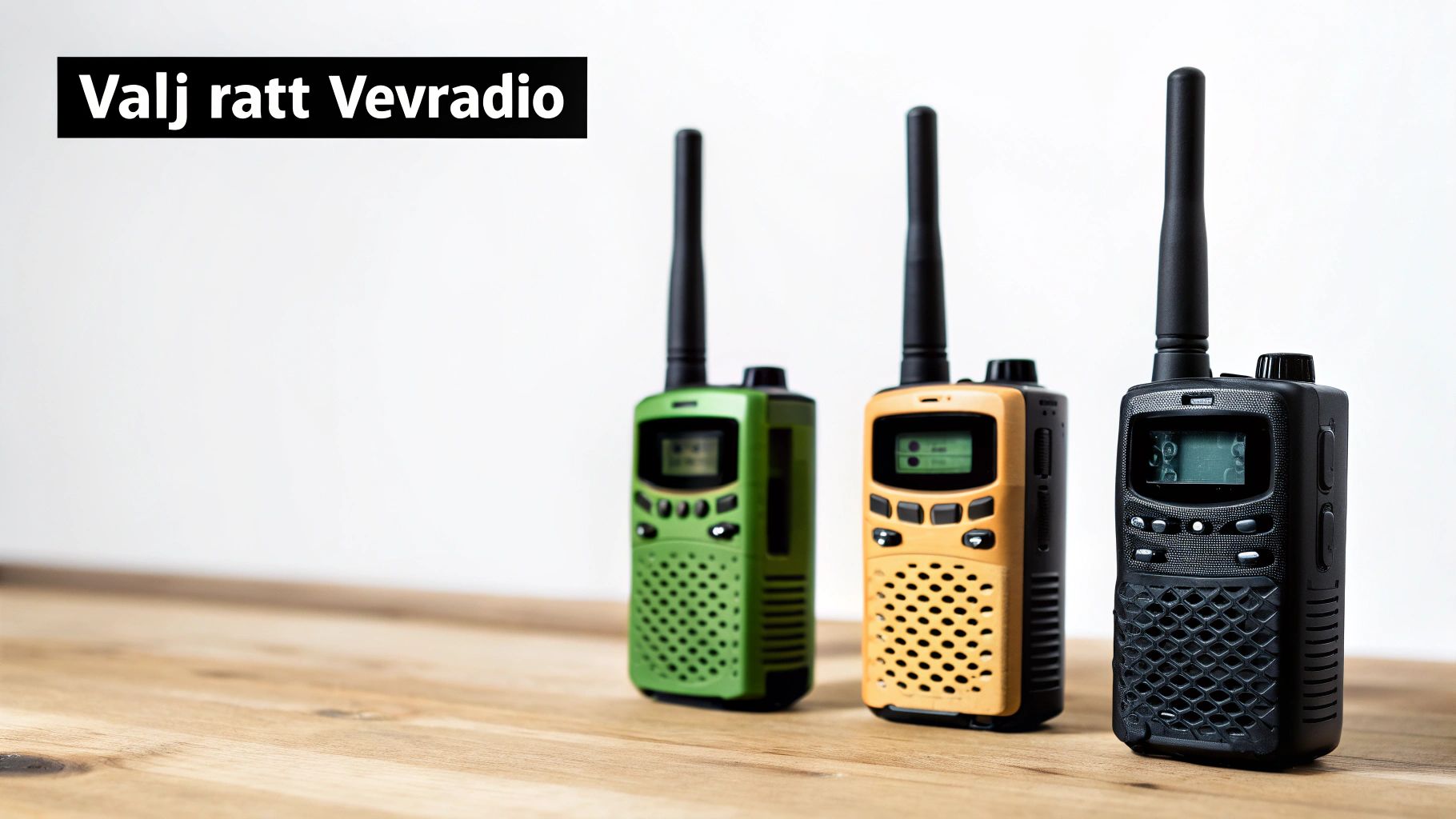
Finding the right crank radio can feel like a jungle with all the models and features available. But it doesn't have to be complicated. Instead of thinking of it as just buying a radio, think of it as a versatile tool for security.
The key is to consider where you will use it. Will it sit in an emergency kit at home? Accompany you on a hike? Or perhaps be a constant companion on a boat? Answering that question will help you immediately filter out models that don't fit and focus on what is important for you specifically.
For outdoor life, a robust and water-resistant design is worth its weight in gold, while a large battery with a power bank function might be more important for home preparedness when the power goes out.
Essential Features Every Crank Radio Must Have
Whether you are a prepper or an outdoor enthusiast, there are some basic functions that are absolutely critical. Consider this a checklist – do not compromise on these.
First and foremost: radio reception. The radio must have stable and clear reception on both AM and FM bands. In Sweden, it is through the FM network, specifically Sveriges Radio P4, that an Important Public Announcement (VMA) is broadcast during a crisis. A radio with poor reception misses the whole point.
Then we have the charging options. A hand crank is a given, but make sure it also has a built-in solar panel. This provides passive maintenance charging when the radio is left out. A USB port is also a must for charging the battery fully from a wall outlet before you depart or when a storm is approaching.
Last but not least, a built-in flashlight. It might sound like a minor bonus, but during a power outage, a reliable light source quickly becomes your best friend. A simple LED lamp draws minimal power but makes an enormous difference.
Advanced Features for Extra Security
Once the basics are in place, it's time to look at the features that elevate a crank radio from "good" to "invaluable." It is often these extra functions that distinguish budget models from high-end variants.
A power bank function is perhaps the most requested feature. Being able to give your mobile phone just enough power for an emergency call or to receive an important message can be life-saving. Check the battery capacity, measured in mAh – a higher value means more juice for your phone.
Being able to charge your phone might feel like a luxury, but in a crisis, it is a communication lifeline. A crank radio with a battery capacity of over 4000 mAh can provide a modern smartphone with a significant charge.
An SOS alarm is another smart feature, especially if you spend time alone in nature. With the press of a button, the radio can emit a piercing sound signal and a flashing light to attract attention.
Finally, durability and water resistance are crucial if the radio is going outdoors. Look for an IP rating that indicates how well it resists dust and water. A rating of IPX4 or higher means it can handle rain showers without issues. Want to maximize your power supply in the field? You can complement it with a more powerful solution like a Nitecore FSP100 portable solar panel to charge both the crank radio and other equipment.
To make the choice a bit easier, we have put together a table summarizing the most important features.
Comparison of Key Features in a Crank Radio
Here is an overview of basic, advanced, and specialized features to help you choose the right model based on your needs.
| Feature Type | Example Feature | Best For |
|---|---|---|
| Basic | AM/FM radio, crank, solar cell, flashlight | All users. A must for basic crisis preparedness. |
| Advanced | Power bank (high mAh), SOS alarm, weather alerts (NOAA) | Home preparedness and outdoor life where communication is key. |
| Specialized | High IP rating (waterproof), digital display, reading lamp | Hikers, boat owners, and those requiring extra robustness and convenience. |
By considering which type of features match your planned adventures or your crisis plan, it becomes much easier to navigate the selection and find a crank radio you can truly rely on.
How Does a Crank Radio Connect to Sweden's Crisis Preparedness?
To truly grasp why a crank radio is so incredibly important for your home preparedness, we need to look at the system it is designed to connect to. In Sweden, we have a well-thought-out plan for how we communicate in a crisis, and at the heart of that plan stands Sveriges Radio P4 as the official emergency channel.
When a serious event occurs, it is P4 that broadcasts an Important Public Announcement (VMA). These aren't just any news stories, but direct information from authorities, created to protect people's lives, health, and property. Without access to P4, you simply risk missing crucial instructions when it matters most.
The Radio's Unique Role in Sweden
Radio has been an integral part of Swedish society for nearly a century. It all began on January 1, 1925, when AB Radiotjänst (which later became Sveriges Radio) launched its first broadcasts. From day one, the goal was to reach the entire population with information, news, and culture. If you want to understand the roots, you can read more about the early days of radio in Sweden.
This role as public service has made radio a rock to lean on, especially in times when other media might not function. Despite living in a digital world full of alternatives, Sveriges Radio still accounts for the vast majority of all radio listening in the country.
FM vs. DAB – Why the Old Way Is the Safest
When a crisis hits, technology becomes decisive, and here there is a huge difference between good old-fashioned analog FM radio and modern digital DAB radio. Sure, DAB can provide crystal-clear sound on normal days, but the technology has its weaknesses during a real crisis.
- The FM Network: This network is extremely robust and covers basically all of Sweden. Transmitters are built to withstand major impacts and the technology is simple, making them much less vulnerable to interference. It just works.
- The DAB Network: Digital technology is significantly more complex, and the transmitter network is far from as extensive. If you live outside the major cities, coverage is often poor or non-existent. This makes DAB an unreliable choice for national crisis preparedness.
It is precisely the robust and nationwide FM network that is the reason why authorities recommend an FM radio in the emergency kit. A crank radio that handles the FM band guarantees that you can receive vital information no matter where you are – and regardless of whether the power grid has collapsed.
Choosing a crank radio with good FM reception is therefore not a nostalgic whim. It is a conscious and smart decision to ensure you always have a direct line to the most critical information channel when everything else goes silent.
Why FM Is Still Best in a Crisis Situation
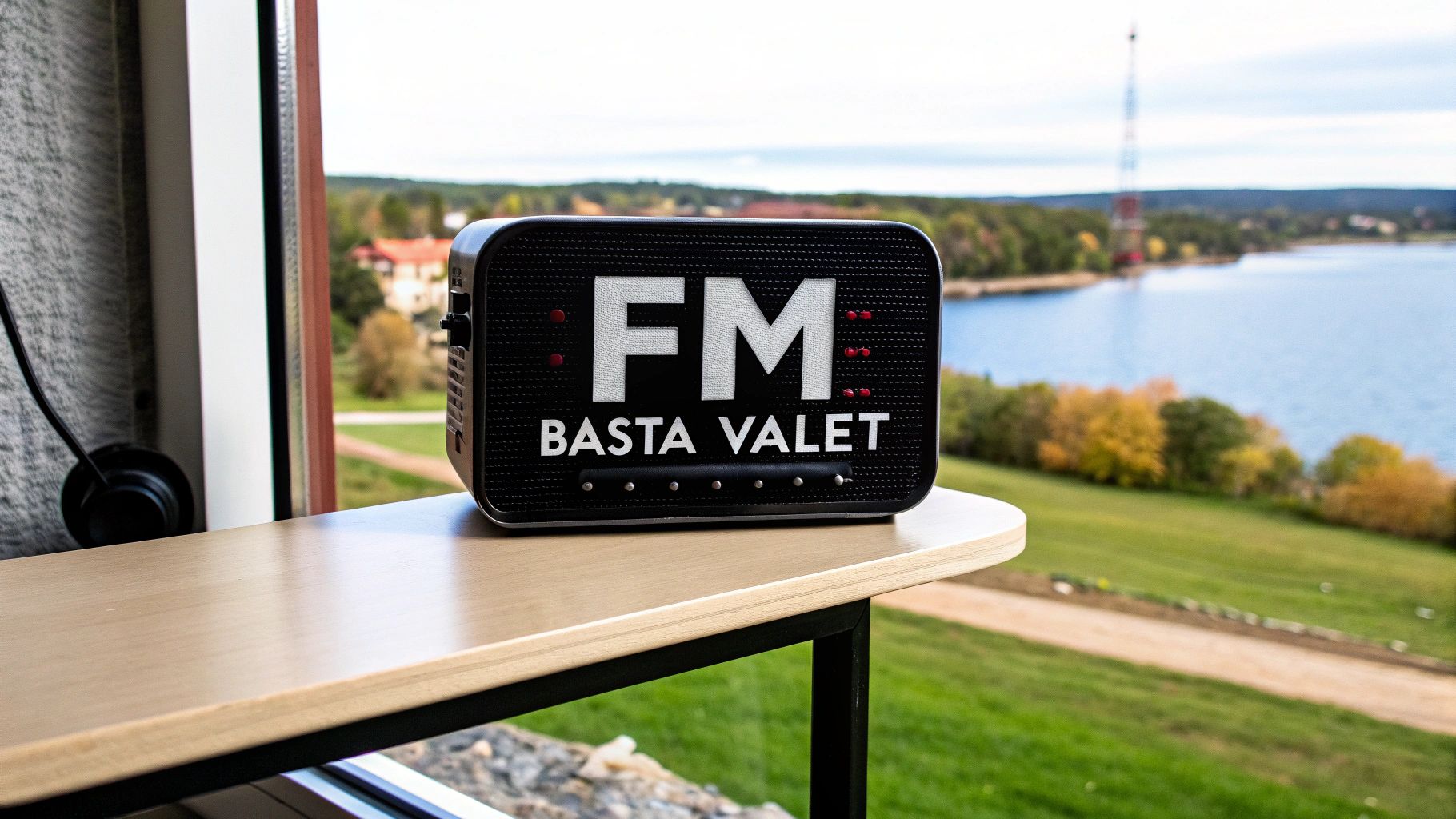
In a world where everything is going digital, it can feel a bit old-fashioned to talk about FM radio. But when it comes to crisis preparedness, old is indeed gold. FM technology is superior to digital alternatives like DAB when it truly matters.
Why is that? The answer is simple: robustness. FM broadcasts are based on a less complicated technology that is much harder to knock out. Think of it like an old Volvo 240 compared to a new electric car – one is built with fewer sensitive parts and keeps chugging along even when conditions are far from perfect.
Furthermore, the FM network in Sweden is extremely well-developed. Transmitters are spread throughout the country, providing geographical coverage that the digital network doesn't even come close to. This ensures you can pick up a signal with your crank radio even if you are far from the nearest city.
The Limitations of the Digital Alternative
Digital Audio Broadcasting (DAB) was launched in Sweden as early as 1995 with grand ambitions to modernize radio. Despite promises of crystal-clear sound and more channels, the brakes were applied and investments were sharply reduced as early as 2002.
Today, the DAB network is practically limited to a few urban areas like Stockholm and Gothenburg. This makes it a direct and unreliable choice for national crisis preparedness. You can read more about the development of DAB in Sweden to understand why the network never really took hold.
This limited coverage is digital radio's Achilles' heel in a crisis. You simply cannot rely on a technology that only works in selected locations.
For crisis preparedness, reliability is everything. The FM network is proven, nationwide, and requires less energy. This makes it the obvious choice for a crank radio that must work when nothing else does.
Another decisive advantage is power consumption. An analog FM receiver generally draws much less power than a digital DAB receiver. When every bit of energy from the crank or solar panel counts, this can mean the difference between hours of extra listening time.
In addition to a reliable crank radio, it's smart to have other communication tools in your preparedness kit. For local communication when the mobile network is down, robust Motorola walkie-talkies are an excellent complement. But when it comes to receiving public information, the choice is clear: a crank radio with strong FM reception is the safest and smartest choice.
Frequently Asked Questions About Crank Radios
Once you've acquired your first crank radio, a few questions usually arise. It's a relatively simple device, but knowing how to best use and maintain it can make all the difference in the world when the time comes.
That's why we've gathered the most common questions in one place. The goal is to give you quick and clear answers so you can feel completely confident with your equipment.
How long do I need to crank to charge the radio?
This is probably the most common question, and the answer, of course, depends slightly on the model. But there is a good rule of thumb: crank at a steady and calm pace, about two revolutions per second. This is more efficient than cranking like crazy.
One minute of cranking generally gives you:
- Approximately 15–20 minutes of radio listening.
- About 20–30 minutes of flashlight use.
It might not sound like an eternity, but remember that this is emergency power you are creating from nothing. A few minutes of active cranking thus gives you well over an hour of radio listening – perfect for catching important news and VMA messages.
The trick is not to crank frantically, but regularly. If you crank a little every day during a crisis, you ensure the battery is always ready when you need it most.
Can I really charge my phone with a crank radio?
Yes, absolutely! But it is super important to have the right expectations. The power bank function is a lifeline for emergency situations, not a replacement for your regular wall outlet. It will not charge your smartphone from 0 to 100%.
Instead, see it as a way to bring a dead phone back to life so you can make an important call or receive a text message. A typical crank radio with a 2000 mAh battery can, after several minutes of intense cranking, provide a modern mobile with enough power to start and stay on for a short while.
A pro tip is to turn off the phone completely while charging. This way, you avoid the screen and apps stealing all the valuable energy you just cranked out.
What is the best way to store my crank radio?
Proper storage is essential for your radio to function flawlessly on the day you truly need it. Just like all other electronics with built-in batteries, it does not do well if left completely discharged in an emergency kit for years on end.
Three simple steps to maximize lifespan:
- Charge fully: Before packing it away, charge the battery fully via the USB cable. This protects the battery's health in the long run.
- Store in a cool, dry place: A closet or storage room at room temperature is perfect. Avoid damp basements and sweltering attics.
- Maintenance charge: Make it a habit to take it out every three to six months. Charge it up, test the radio and the flashlight. That way, you know everything works and the battery stays fresh.
By following these simple tips, you ensure that your investment is ready to deliver when you need it most.
Which radio channel is most important during a crisis?
In Sweden, there is a simple and crystal-clear rule: Sveriges Radio P4 is the official emergency channel. It is via your local P4 channel that authorities broadcast VMA (Important Public Announcements).
Regardless of where you are in the country, your local P4 frequency is the most vital lifeline for information. Find out which frequency applies to your region and consider pre-setting the radio to it.
When the power is out and the mobile network is down, it is P4 that tells you what is happening, where you can find help, and how you should act. It is one of the simplest but most powerful parts of good crisis preparedness.
To build a complete emergency kit or find reliable gear for your adventures, visit ActionKing for a wide range of everything from power banks and lighting to advanced accessories for your action camera. Find your next gadget at https://actionking.se.


